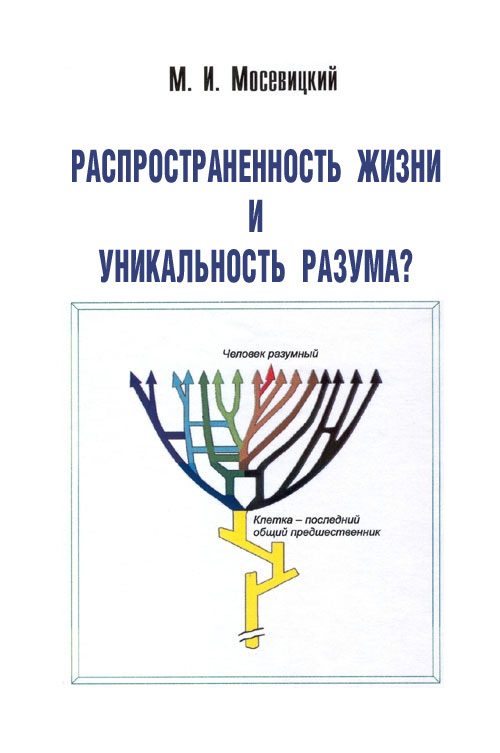
Распространненость жизни и уникальность разума?
Скачать
Начало книги
Мосевицкий Марк Исаакович – главный научный сотрудник Отделения молекулярной и радиационной биофизики Петербургского института ядерной физики им. Б.П. Константинова РАН, доктор биологических наук, профессор. В настоящее время основная область научных интересов – молекулярные механизмы обучения и памяти.
M.I. Mosevitsky. Wide spreading of life and uniqueness of mind?
Publishing division of Petersburg Nuclear Physics Institute, Russian Academy of Sciences.
Traces of cellular forms of life were found in the earliest sediments (3.85 billion years of age). Therefore, life on the Earth arose soon after the environment became compatible with its existence. It means that precellular evolution was performed in a very short time (10–50 million years). Another possibility – accomplishment of precellular evolution elsewhere, and arrival of viable cell to ready for its multiplication Earth (panspermia). In any case, the Earth’s experience shows that the probability of life appearance on other planets of our system and in other worlds was rather high. However, the paleontological chronicles evidence numerous crisises (extinctions), which caused tight bends of evolution process. The main causes of the crisises were collisions with asteroids (impacts), global glaciations, long-term lava outflows, changes of gas balance in the oceans and atmosphere. Mutations and horizontal genetic exchanges also exert countless influences on the evolution. Due to superposition of different accidental events all evolution processes are uncial. After almost 4 billion years of life development on the Earth, the evolution process produced a single branch of hominins (the bipedal successors of chimpanzee) leading to the intellectual beings.
- Жанр
- Физика, Биология, биофизика, биохимия, Научная литература
- Год написания
- 2013
- Издание
- ПИЯФ РАН, Санкт-Петербург, 2008
- ISBN
- 5-86763-203-2
- Язык
- ru
- Размер FB2
- 1,9 МБ
- Добавлена