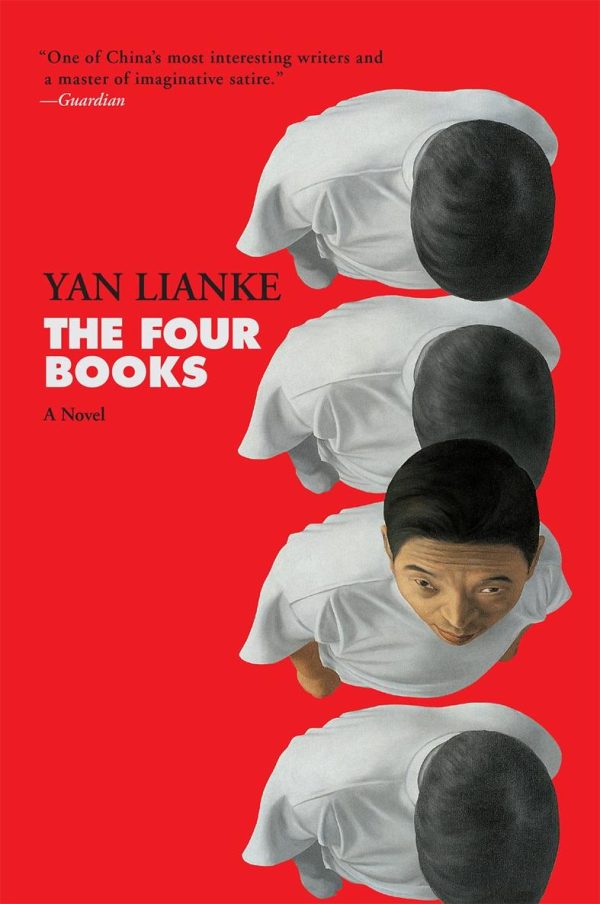
The Four Books
Скачать
Начало книги
Yan Lianke has noted that whenever he travels abroad, he is invariably introduced as “China’s most controversial and most censored author.” He claims he is neither honored nor annoyed by this characterization, but points out that in contemporary China’s publishing environment, it would be unusual for a serious author to never run into problems with the censors.1
The Four Books, Yan Lianke’s novel about the Great Leap Forward (1958–1961), reflects on similar issues of literary production and political supervision. Following on the heels of the Hundred Flowers Campaign (1956), which encouraged citizens to express criticisms of the regime, and the Anti-Rightist Campaign (1957), which labeled many of those same citizens as rightists and sentenced them to compulsory re-education, the Great Leap Forward began as a set of policy directives designed to jumpstart China’s economy so that it might overtake that of Great Britain in fifteen years. The resulting emphasis on rapid industrialization and collectivization, however, had catastrophic consequences — including a nationwide famine that claimed the lives of tens of millions of people. Although the government refers to this period as the “three years of natural disaster,” it is nevertheless widely acknowledged that the crisis was in large part a result of a set of tragically misguided political decisions. Yan Lianke’s novel is unusual in that it offers a detailed exploration, in fictional form, of some of the policy mistakes and human tragedies that unfolded during this period. While there are many Chinese literary works that offer a critical perspective on the more recent Cultural Revolution (1966–1976), there are as yet relatively few works that attempt to do the same with respect to the Great Leap Forward and its aftermath.
- Жанр
- Современная русская и зарубежная проза
- Перевод
- Carlos Rojas
- Оригинальное название
- 四书
- Издание
- Grove Press, 2015
- Язык
- en
- Размер FB2
- 768,8 КБ
- Добавлена