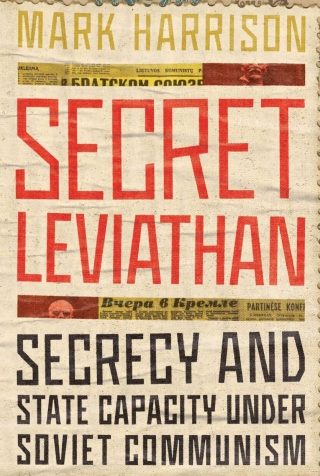
Secret Leviathan
Скачать
Начало книги
As a student and young scholar in the 1960s and 1970s, I grew up with the idea that the Soviet Union was secretive. I was interested in communism, and I wanted to learn more about it, but I found that many lines of enquiry were closed off by secrecy. Visiting Moscow, I also learned that curiosity was dangerous, especially to those that lived there. As an outsider, I could hope to study the Soviet economy and its history only through the smoke and mirrors of censored documents and statistics.
In 1986, a new leader of the Soviet Union announced a new policy: “openness.” A trickle of historical revelations began. At the end of 1991, to the surprise of many, the Soviet Union collapsed. For the first time, independent scholars were allowed into many of the formerly secret archives of the Soviet state.
On a dull day in the mid-1990s, I sat at a desk in the Russian State Military Archive. After tea and cakes with Vera and Nonna, I went back to the documents. They told me how the Red Army went about buying new weapons from state industry in the 1930s. Industry was supposed to be planned, but the rapid changes of military technology were a factor that no plan could anticipate. The result was a relatively decentralized process. Every year, high-ranking military engineers toured the defense factories, looking for plant directors that would take on contracts to supply new tanks and planes. While the public could see nothing of this, the Defense Ministry was supposed to have full access to the factories’ capabilities and costs. But many reports told the same story: the biggest problem facing the Army’s buyers was the walls of secrecy that the factory directors and middle managers threw up around their offices to keep the soldiers out.
- Жанр
- История, Публицистика
- Издание
- 2023
- Язык
- en
- Размер FB2
- 1,1 МБ
- Добавлена