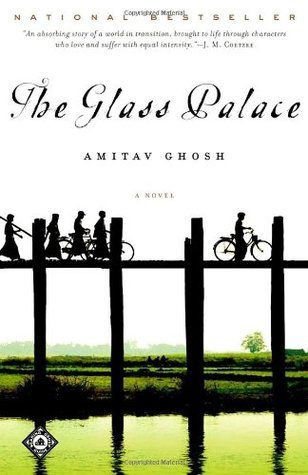
The Glass Palace
Скачать
Начало книги
pp. 16–17: adapted from W.S. Desai, Deposed King Thebaw of Burma in India, 1885–1916, Bharatiya Vidya Series, Vol. 25, Bharatiya Vidya Bhavan, Bombay, 1967 (appendix VII, p. 119)
p. 95: adapted from Patricia Herbert, The Hsaya San Rebellion (1930–1932) Reappraised, Monash Univ., Melbourne, 1982 (p. 5)
p. 372: from Majjhima Nikaya [adapted from The Buddhist Tradition in India, China and Japan, ed. W.T. de Bary, Vintage, New York, 1972; p. 27]
p. 373: from Samyutta Nikaya [adapted from The Buddhist Tradition in India, China and Japan, ed. W.T. de Bary, Vintage, New York, 1972; p. 16]
There was only one person in the food-stall who knew exactly what that sound was that was rolling in across the plain, along the silver curve of the Irrawaddy, to the western wall of Mandalay’s fort. His name was Rajkumar and he was an Indian, a boy of eleven — not an authority to be relied upon.
The noise was unfamiliar and unsettling, a distant booming followed by low, stuttering growls. At times it was like the snapping of dry twigs, sudden and unexpected. And then, abruptly, it would change to a deep rumble, shaking the food-stall and rattling its steaming pot of soup. The stall had only two benches, and they were both packed with people, sitting pressed up against each other. It was cold, the start of central Burma’s brief but chilly winter, and the sun had not risen high enough yet to burn off the damp mist that had drifted in at dawn from the river. When the first booms reached the stall there was a silence, followed by a flurry of questions and whispered answers. People looked around in bewilderment: What is it? Ba le? What can it be? And then Rajkumar’s sharp, excited voice cut through the buzz of speculation. ‘English cannon,’ he said in his fluent but heavily accented Burmese.
- Жанр
- Современная русская и зарубежная проза
- Издание
- Random House Trade Paperbacks, 2002
- Язык
- en
- Размер FB2
- 1,1 МБ
- Добавлена