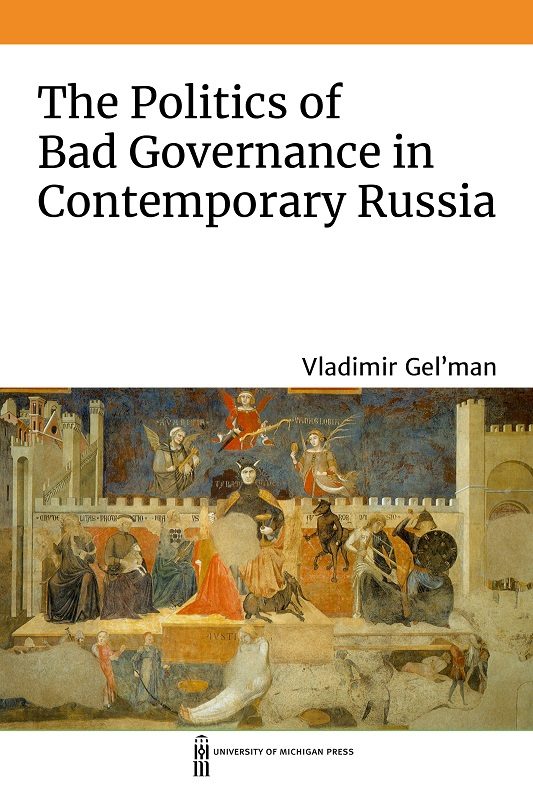
The Politics of Bad Governance in Contemporary Russia
Скачать
Начало книги
In this book, I would like to challenge a conventional wisdom that dominates the research of governance and development, namely the assumption that all countries, at least in theory, aim to improve their performance in order to achieve prosperity, and exceptions from this rule can be considered deviations. Such a view is typical for academics who teach their students with the mission of promoting scholarly excellence—we all want to be proud of our A-students with excellent grades, great knowledge, and outstanding skills. However, I grew up in communities of C-students within the late-Soviet educational establishments, where almost nobody cared about gaining knowledge, where the scholarly cheating was nearly ubiquitous, and where the skills of making good informal connections4 paved the way for high grades and better jobs. Those A-students who behaved otherwise (myself included) were regarded as outsiders in these communities, to say the least. Over time, I realized that communities of C-students—in Russia and elsewhere—are the norm, and A-students are almost an exception, rather than the reverse. C-students may convert themselves into A-students (similarly to the conversion from Saul to Paul the apostle) only under serious pressure that may provide strong incentives for improving their performance. Without these incentives, C-students will not pursue academic excellence (even though many of them could perform much better) but rather will prefer some manner of muddling through to minimize their scholarly efforts, showing little care about their future. In the worst-case scenario, they may demonstrate educational decay and deterioration in various political and institutional contexts and even irreversibly turn into F-students.
- Жанр
- Политика
- Издание
- Univeristy of Michigan Press Ann Arbor, 2022
- Язык
- en
- Размер FB2
- 1,9 МБ
- Добавлена