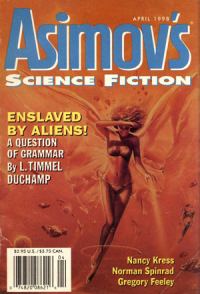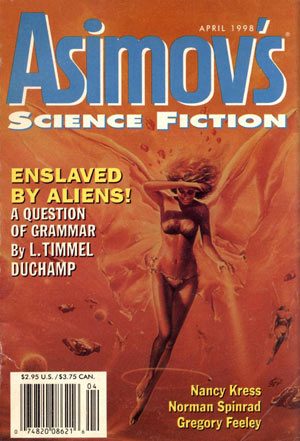
Animae Celestes
Серия: Asimov's Science Fiction 1998-04
Скачать
Начало книги
All happy theories are alike; each generation reacts to them in its own way.
In 1489 Marcilio Ficino wrote of the spiritus, a vapor which circulates throughout the nervous system, conveying sensory perception and mediating between the corporeal body and the immortal soul. A valuable faculty: yet while soldiers take care of their weapons, as musicians do their instruments and hunters their hounds, “the priests of the Muses, who seek the highest truth and good, are careless enough (alas) to neglect an instrument by which one can measure and grasp the whole world. Such an instrument is the spirit… Formed from the subtler blood by the heart’s heat, it flies to the brain, where the soul employs it assiduously for both the interior and the exterior senses.”
This small book was posthumously collected with others in Ficino’s Opera Omni, published in an expensive edition (there was in 1576 no other kind) in Basel, and distributed throughout the libraries of the learned. In 1713 Henri Lavalle, a natural philosopher at the University of Paris, read the study and exclaimed, “Of course—it is the esprits of Descartes, dimly prefigured by the Florentine Platonist. The body, in short, is a perfect mechanism, like the nested spheres of the heavens, and the spiritus is aether.” In 1849 Odeon Puysage, an engineering student studying Renaissance science, came upon Ficino’s tract and observed in his notes that “Spiritus = systeme pneumatique. ‘Cordis Calore’—cf. la puissance motrice du feu (Carnot).” Reading in search of a topic for his doctoral thesis, Emile Weissmann found the fat marbled volume (rebound by the librarians some decades earlier) in 1908 and told his skeptical advisor that “The spiritus acts as doorkeeper to the ego.
- Жанр
- Научная фантастика
- Год написания
- 1998
- Издание
- Dell Magazines, 1998
- Язык
- en
- Размер FB2
- 366,0 КБ
- Добавлена